Research
Exploring the intersection of artificial intelligence, robotics, and human behavior through computational approaches. My research focuses on developing adaptive systems that can learn, reason, and interact effectively in complex environments.

Adaptive Motion Planning for Humanoid Robots
MOCCA Lab, UBC Computer Science · Dr. Michiel Van de Panne
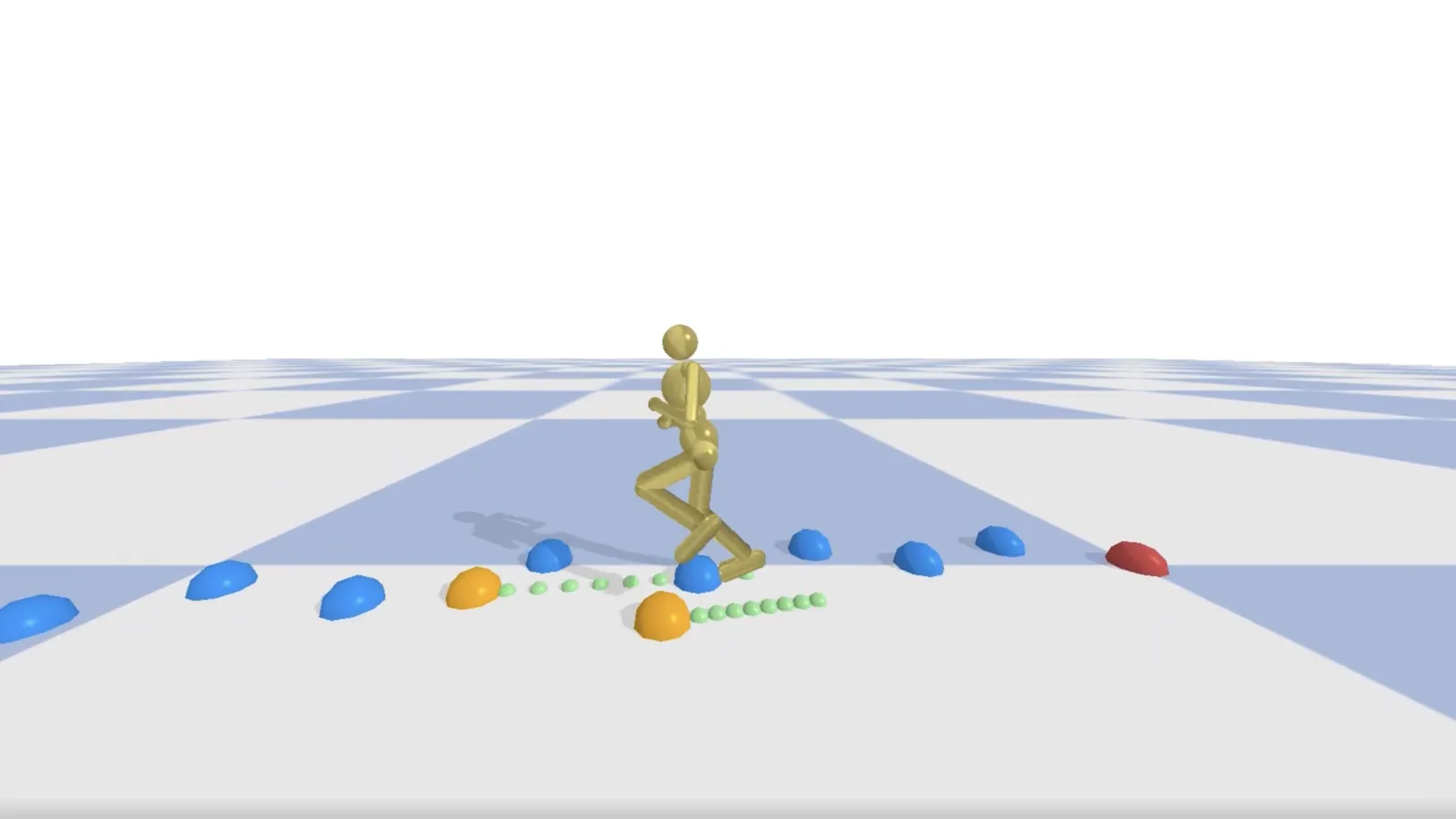
Developing robust control policies for humanoid robots to navigate challenging terrains using deep reinforcement learning techniques.
This research explores the application of deep reinforcement learning algorithms to enable humanoid robots to walk robustly across diverse and challenging terrains. We investigate novel architectures that can adapt to environmental changes in real-time that are more efficient, including uneven surfaces, obstacles, and external disturbances. The work uses simulation-based training to demonstrate same performance with a simpler model that is less resource intensive. We use a procedural generator with a high-level policy to determine the plans that are viable in the long term by attempting to replace planning by a diffusion model that is very time and resource consuming.

ContagionRL: A Flexible Platform for Learning in Different Spatial Epidemic Environments
UBC Mathematics & Computer Science · Dr. Daniel Coombs
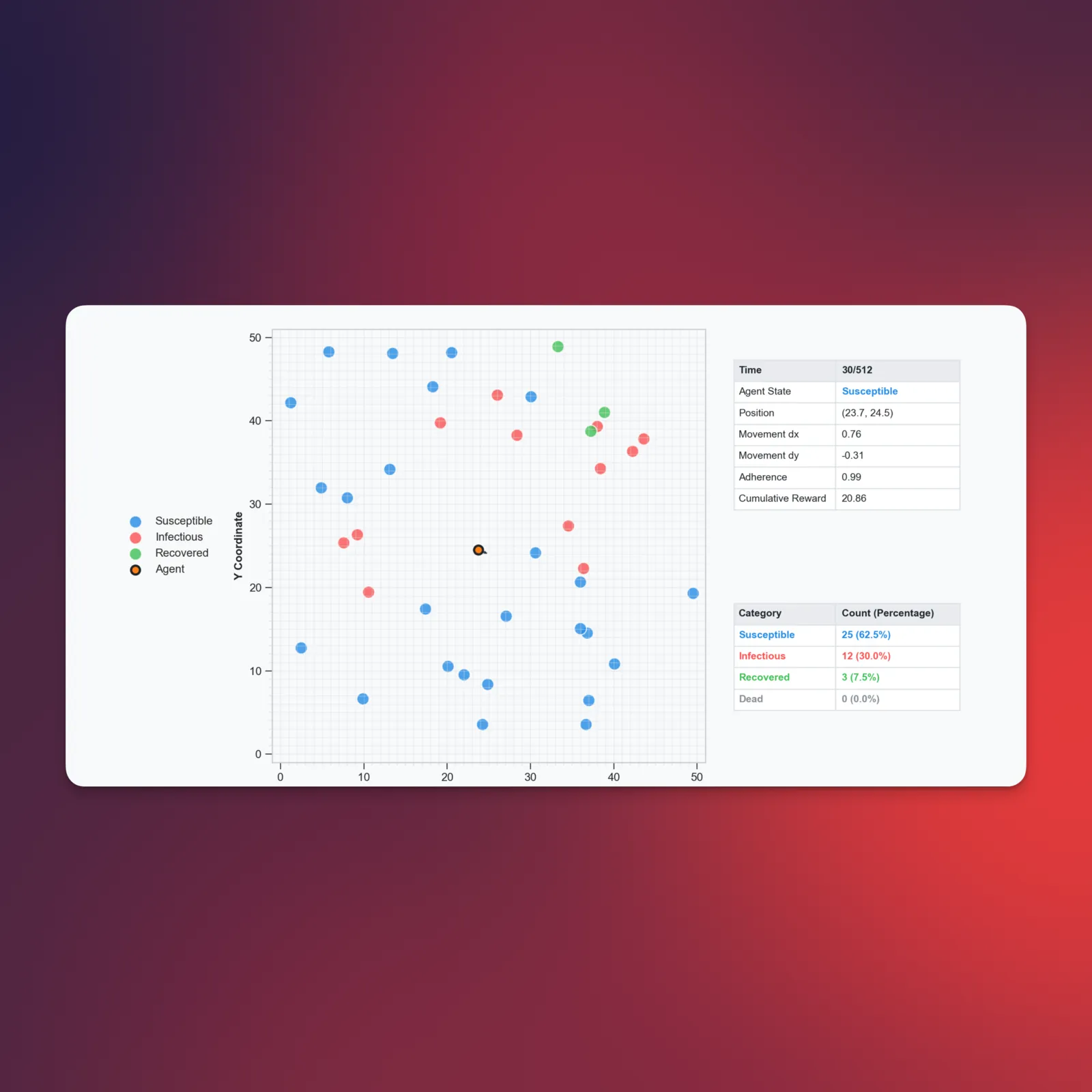
ContagionRL simulates human behavioral responses during epidemics using reinforcement learning, combining a spatial SIRS disease model with single-agent RL.

Adaptive human behaviors, such as movement and adherence to non pharmaceutical interventions (NPIs), shape epidemics. However, existing models struggle to capture individual decision making under realistic spatial dynamics. We introduce ContagionRL, an environment adhering to the Gymnasium interface which integrates a spatial Susceptible-Infected-Recovered-Susceptible (SIRS) model with an explicit death compartment and a single agent reinforcement learning (RL) framework. In each simulation, the learning agent navigates a toroidal grid and adjusts its adherence to non-pharmaceutical interventions amid a population of non-learning individuals. ContagionRL supports Proximal Policy Optimization (PPO), Soft Actor-Critic (SAC), and Twin Delayed Deep Deterministic (TD3) Policy Gradient algorithms and offers more than twenty configurable parameters, enabling systematic exploration of diverse outbreak scenarios. We evaluate five reward designs, ranging from a sparse survival bonus to a novel potential field reward that treats infected individuals as repulsive forces. We benchmark the resulting policies against different baselines. Agents trained with the potential field reward achieve the longest survival times, outperforming naive strategies and matching a heuristic with privileged information. Ablation studies identify directional guidance and explicit incentives for intervention adherence as the principal drivers of robust, risk-averse behavior. By providing a flexible simulation platform for reward design and spatial epidemic modeling, ContagionRL facilitates the development of data driven, behaviorally informed intervention strategies.
Entrepreneurship Education Research
UBC Computer Science and Sauder School of Business · Dr. Angele Beausoleil
An NLP-based system that automatically analyzes and maps entrepreneurship education programs and course syllabi against defined competency frameworks using zero-shot classification.
This research develops an automated pipeline for evaluating entrepreneurship education programs by analyzing web-scraped program descriptions and course syllabi against established entrepreneurial competencies. The system uses Facebook's BART-large-mnli model for zero-shot classification to score programs and courses on various competencies, then generates comparative visualizations through heatmaps. The approach addresses the challenge of systematically assessing competency coverage across diverse educational programs, providing educators and institutions with data-driven insights for curriculum development and program improvement.

Monte Carlo Protein Engineering: Conformational Optimization and Systematic Mutagenesis Analysis
UBC Life Sciences Institute (LSI) · Dr. Steven Halem
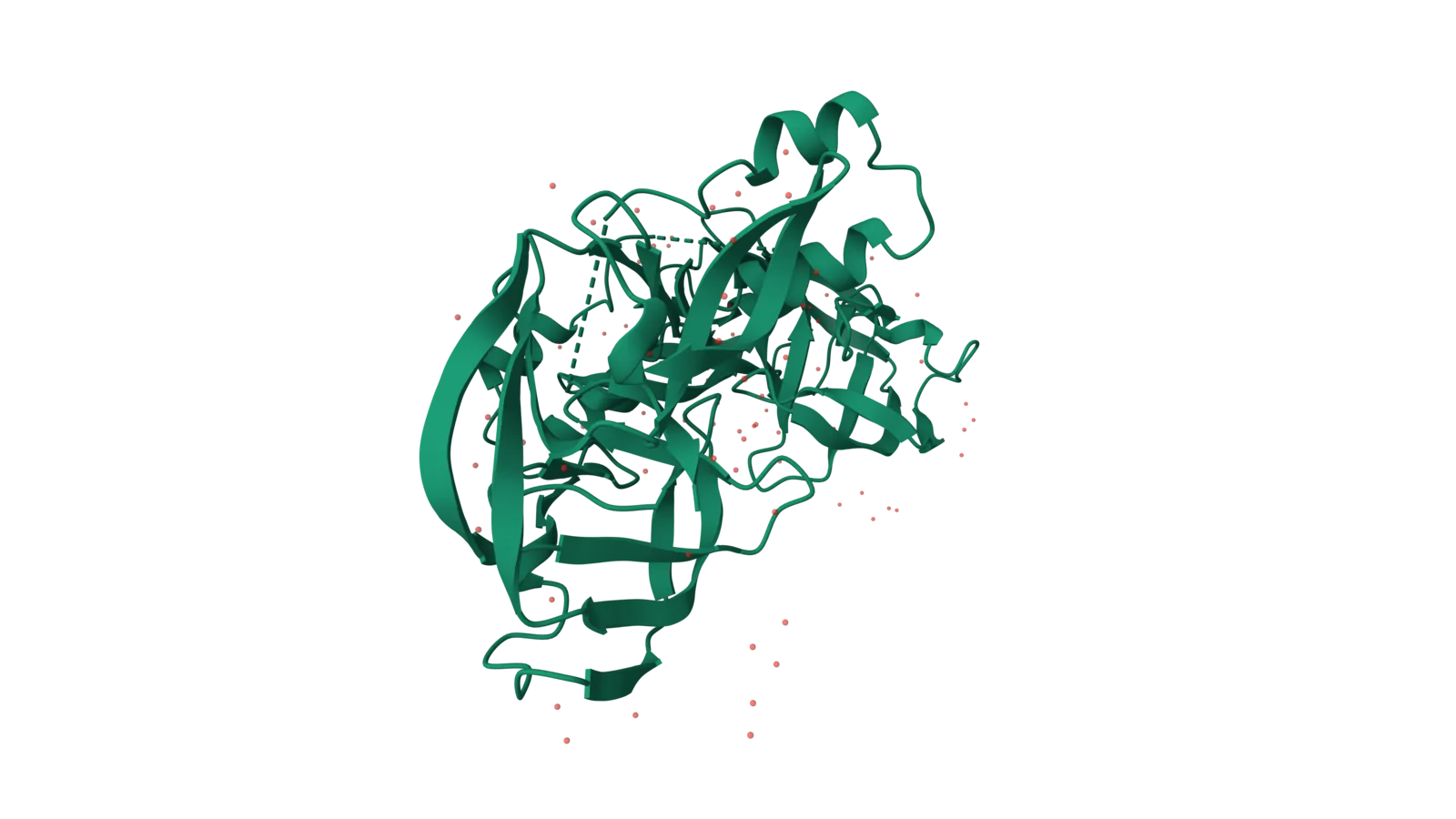
A Monte Carlo protein optimization system that uses PyRosetta to systematically explore protein conformations and evaluate single amino acid mutations for enhanced stability and functionality.
This project implements a comprehensive protein engineering pipeline that combines Monte Carlo simulations with systematic mutagenesis analysis. The system performs two main functions: (1) Monte Carlo conformational sampling using backbone and sidechain perturbations with energy minimization to generate optimized protein decoys, and (2) exhaustive single amino acid mutation analysis that evaluates all possible point mutations across the protein sequence. For each mutation, the system calculates key biophysical properties including full-atom energy scores, ΔΔG values, hydrogen bonding patterns, solvent accessible surface area (SASA), and secondary structure changes. The pipeline supports parallel processing through PBS job arrays and generates comprehensive CSV datasets for downstream analysis. R scripts are included for statistical visualization of mutation effects, providing insights into which amino acid substitutions and protein regions are most sensitive to change.